ActivAI Architecture & Technology
The Core Architecture
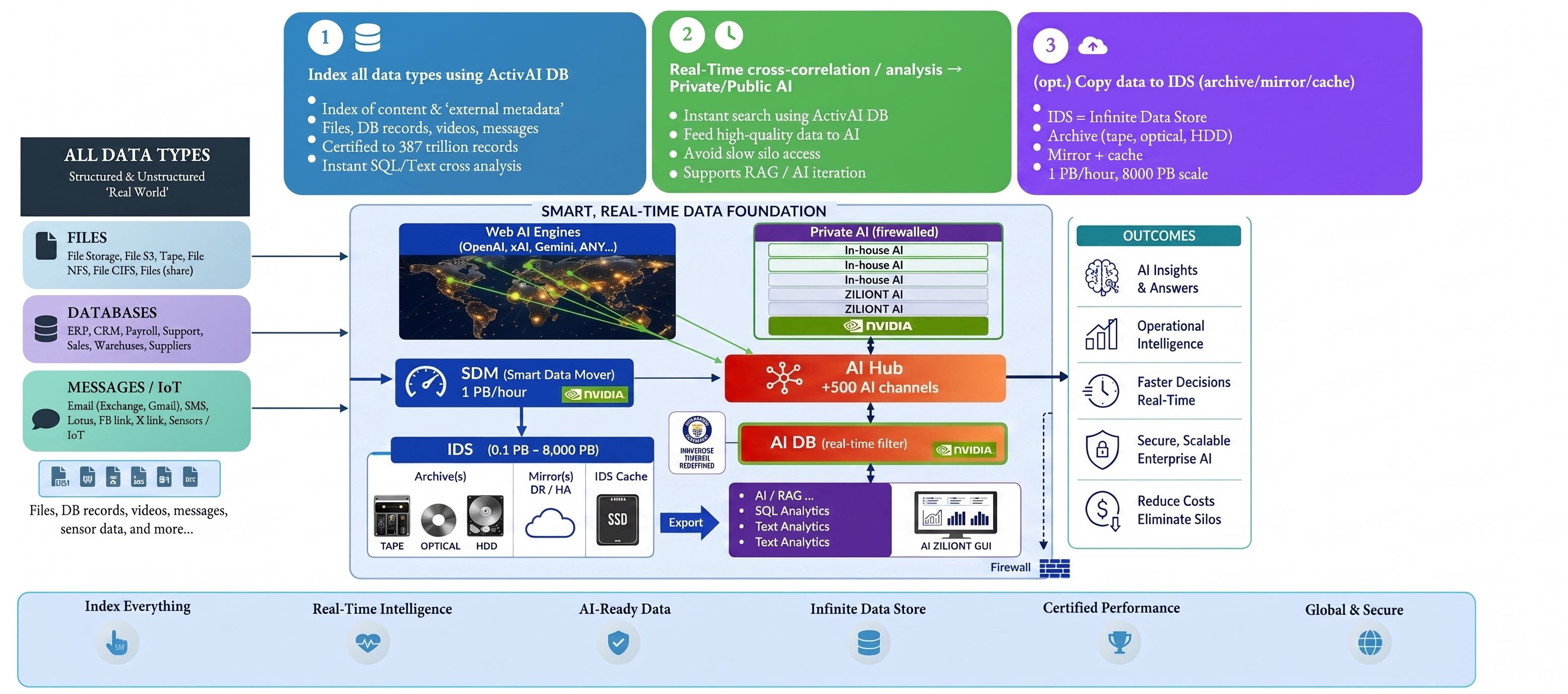
ActivAI is built to roam across the entire enterprise data estate—structured and unstructured—and unify it into one intelligence layer. It handles files, videos, images, emails/SMS, IoT streams, and database records without forcing teams to redesign how data is produced. The core idea is simple: wherever your data lives—cloud, on-prem, or hybrid—ActivAI connects to it once and makes it searchable and usable - without accessing it again. Instead of treating storage as a dead end, ActivAI treats storage as the beginning of a workflow: index, search, analyze, and reuse.
Security and durability are architectural, not optional: ActivAI can store data on long-retention, ransomware-resistant media such as WORM for decades-long protection. Governance is native, with automated retention, deletion, and policy control so compliance is part of the system, not a manual afterthought.
The platform is designed for massive scale, from early petabyte deployments to multi-petabyte estates, while staying operationally calm. A key differentiator is visibility: you don’t “store first and discover later”—ActivAI makes it clear what you have and why it matters. The result is an architecture that supports both human search and AI-ready workflows from the same foundation. And it’s built to be approachable, so executives can run meaningful queries without heavy training, while technical teams still get depth and control.
How the Data Flow Works
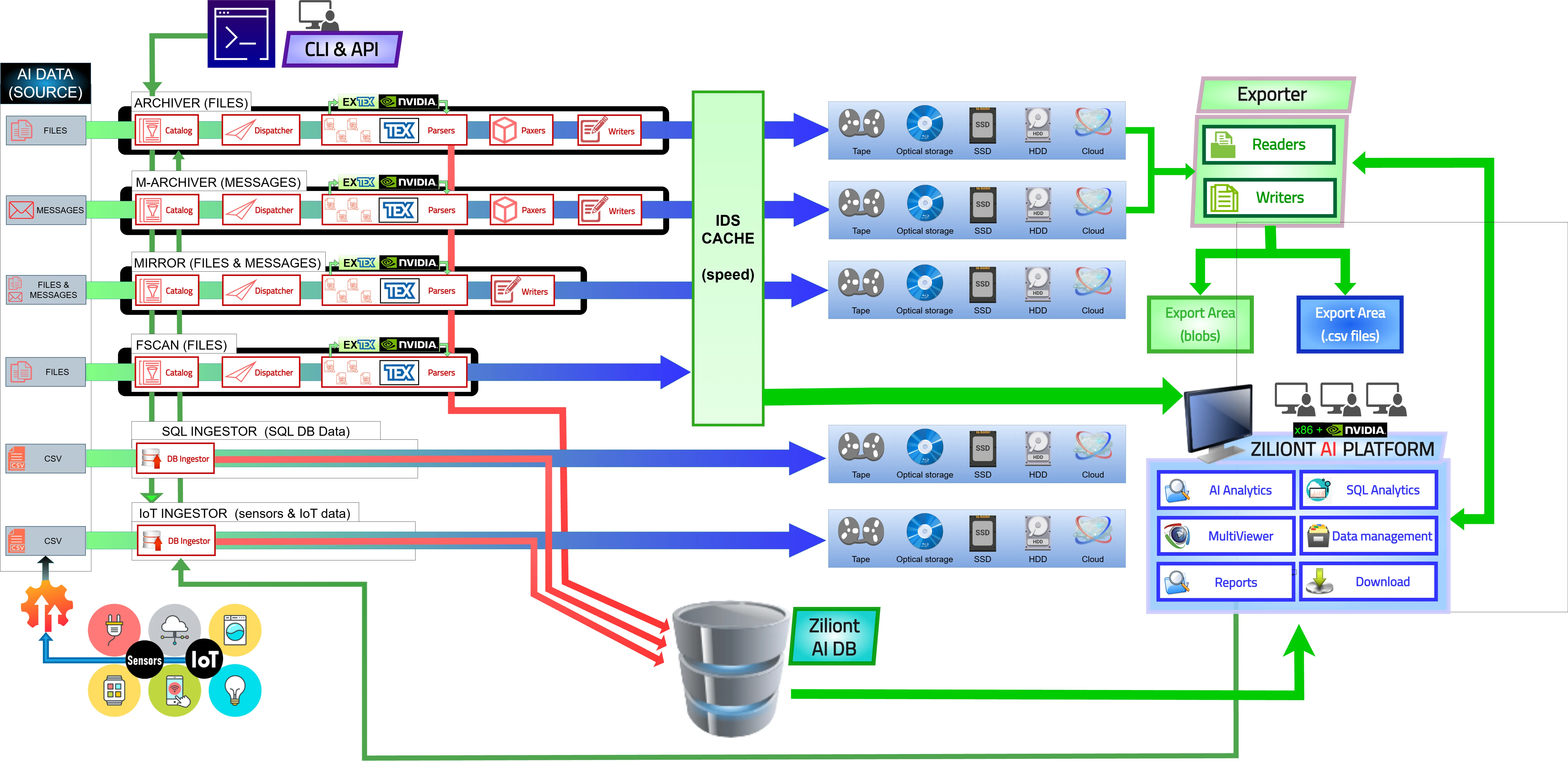
ActivAI turns scattered systems into a repeatable flow: connect, index, analyze, and make results reusable. It can index file servers directly and can also mirror sources when cloning and parallel indexing are needed for scale and resiliency. Once connected, ActivAI doesn’t stop at metadata—it analyzes both content and structure so search is more than “find the filename”. A major breakthrough is combined text and numeric analysis using SQL, so you can query across documents, messages, and database records without having to use different tools or export data.
For high-volume environments, ActivAI can analyze petabytes of IoT data efficiently and can cross-correlate with database records through familiar SQL patterns. This creates an intelligence layer where teams can ask real questions—filters, trends, anomalies, and relationships—without first building a new pipeline. AI and ML tools are integrated as part of the flow, helping discover what teams don’t yet know to look for.
Outputs can feed back into the system, improving the index and making future search and analysis smarter and faster. Automation is built in: auto-storing, retention rules, and deletion policies can run continuously once configured. Finally, access stays simple—users and applications can search through a clean interface and integrate via API and SQL so ActivAI can plug into existing workflows or run standalone.
Infinite Scalability with Efficiency
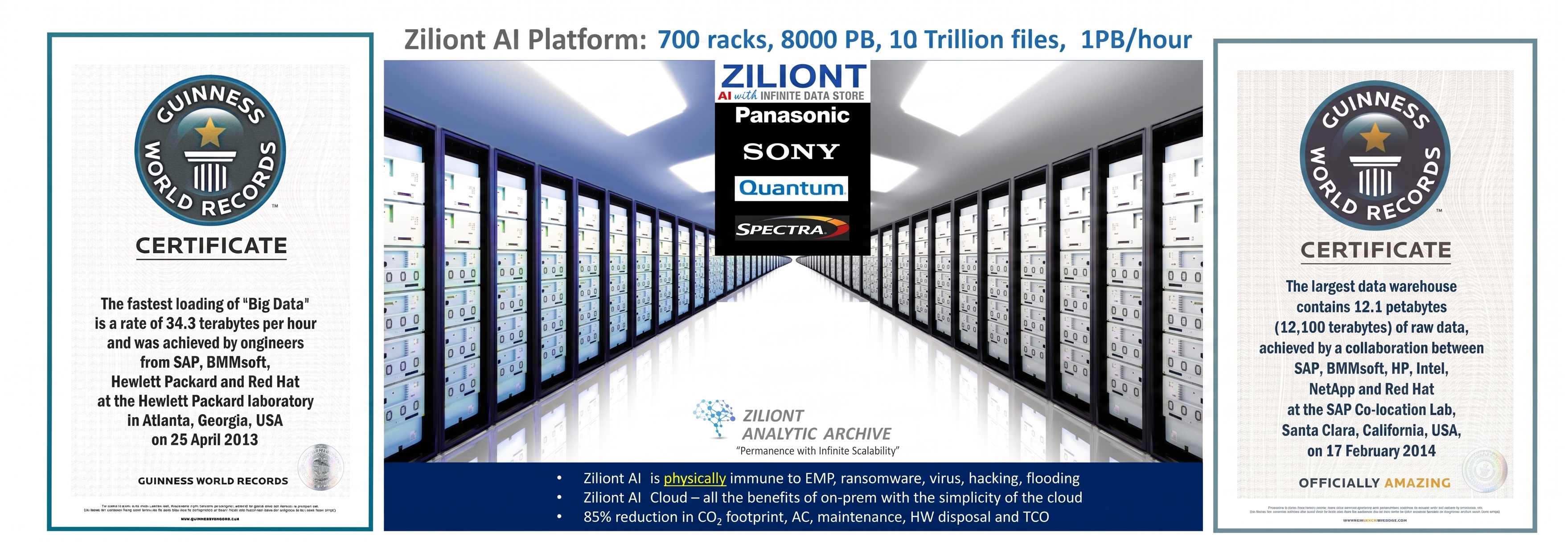
ActivAI is designed for “infinite” scale in the practical enterprise sense: grow from around 0.1 PB up to 8,000 PB without changing the fundamental approach. We combined compute efficiency with data compression - and the result is that in most cases ActivAI can index and store 1PB of data in single 1U server that consumes less than 1kW and weighs under 40 lbs - which makes it ultra-portable and green. It pairs that scale with high throughput—up to 2 PB per hour for storage and ingest—so growth doesn’t automatically create backlog. The platform supports any data type and any deployment model: cloud, on-prem, or hybrid, with single-node or multi-site configurations as needed.
Scalability isn’t only about size—it’s also about efficiency, simplicity, low cost: 85% reduction in power usage, CO2 carbon footprint and floorspace, drama-free deployment (on-prem, cloud or hybrid) and scaling as volumes grow. Optimal cost means customer is not forced into expensive all-flash storage or complicated tiering models - all this is natural part of ActivAI. The same efficiency shows up in operations: fast results, instant reporting with filters, and the ability to search content—not just metadata. AI and ML help identify high-value data, surfacing what matters even when teams don’t yet know what to ask for. Caching enables rapid access to multiple files when speed matters, turning archives into active assets rather than slow storage.
Compared to legacy archives that require complex retrieval steps and long wait times, ActivAI emphasizes direct access and immediate insight. Media flexibility keeps options open over decades, supporting current and future storage choices as technologies evolve. The end result is a platform you can deploy quickly, integrate cleanly, and scale for years—without turning data growth into chaos.